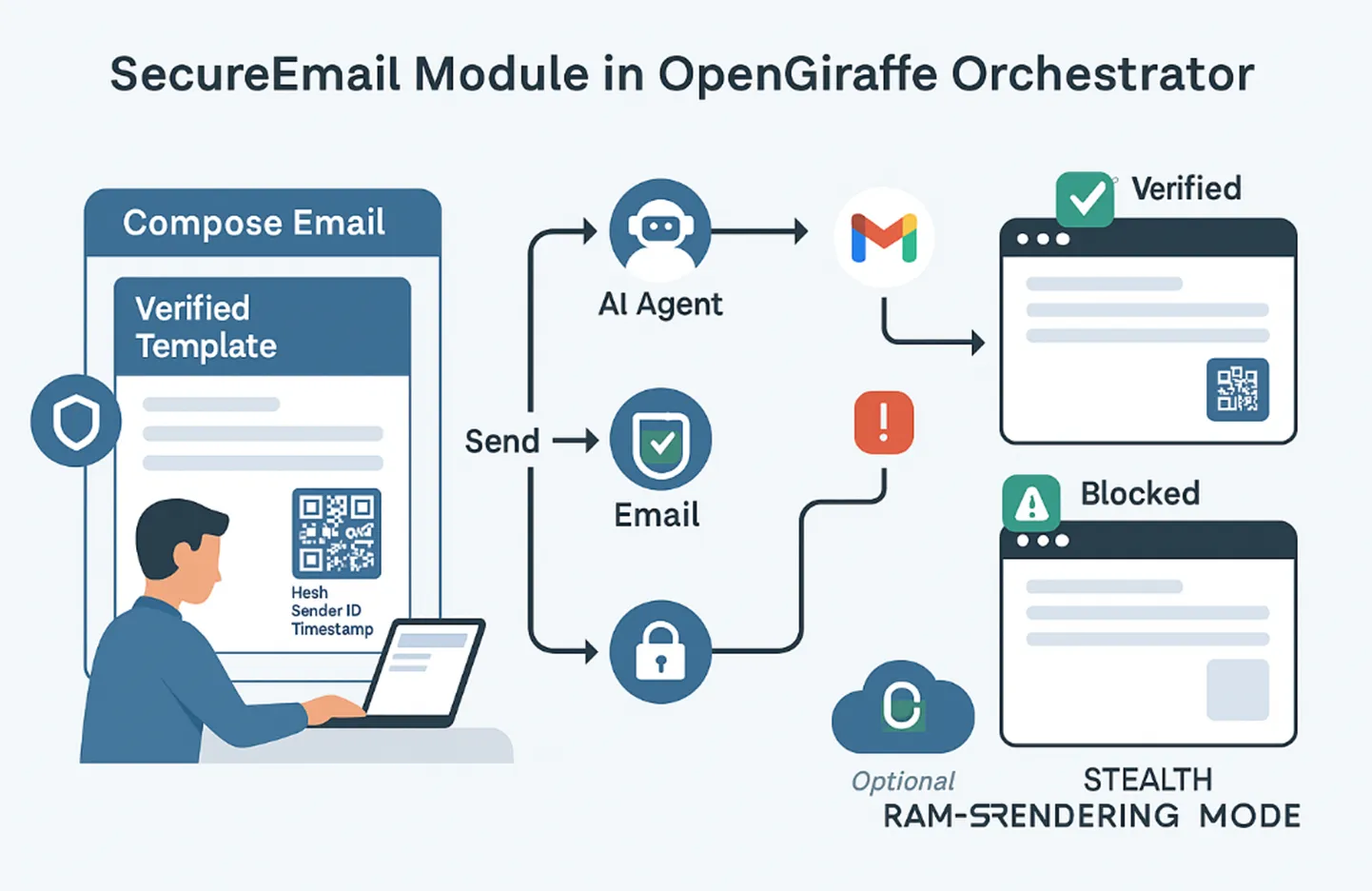
The SecureEmail Module is a security extension within the OpenGiraffe Orchestrator, designed to prevent phishing, spoofed identities, and tampered emails. It enforces WRCode-anchored, auditable templates and attachments designed to prevent phishing, spoofed identities, and tampered emails. It enforces WRCode-anchored, auditable templates and attachments via a zero-trust security model. Integrity is enforced using Merkle-based validation, local tamper-proof storage (PostgreSQL, MDIKS), and blockchain anchoring. Public anchors are submitted to performant blockchains like Solana and Optimism. IOTA provides an additional archival integrity layer for long-term traceability.
- How It Works
- Only verified WRCode users can log into the composer via WRCode scan, initiating a session that cryptographically links email generation to their WRCode.org account.
- These are published on WRCode.org and anchored on high-performance blockchains such as Solana or Optimism for real-time and audit-grade verification. Optionally, a batched Merkle-root may be submitted to IOTA for long-term archival purposes only.
- WRStamped Email Sending Process
- When the user clicks “Send,” the following steps occur:
- 🔐 Hashing
- The entire email body and all attachments are hashed together to create a single canonical digest.
- 📦 The resulting hash is:
- 🔗 Anchored on Solana or Optimism for immutable, timestamped integrity verification.
- 🧾 Embedded in the email footer as a WRCode (visual representation and manual verification or automation trigger).
- 📬 Included as an X-Header for automatic detection and validation by WR-aware email clients.
- 🧷 Used to validate WRStamped attachments, ensuring they match the original content.
- 🌍 Combined with the geographic region of the sender and included in the WRStamp context.
- 🔑 The recipient’s public key is automatically retrieved from a WRGuard-verified record, linked to the recipient’s email identity. The message is optionally encrypted using this key, ensuring that only the intended recipient can decrypt it. No manual key exchange is required. Encryption is recommended for sensitive data, but not required for WRStamped email participation. However, secure opening (e.g., in a sandboxed orchestrator container) is mandatory for interacting with critical templates (e.g., forms, payment instructions). The sender’s proof of origin is derived from a locally resolved, coarse-grained location signal (e.g., IP or mobile network). A cryptographic algorithm converts this into a verifiable statement about the sender’s broader region (e.g., “Western Europe” or “North America”), without referencing city-level or exact locations. This regional statement is then anchored cryptographically as a zero-knowledge token — making it publicly verifiable while preserving sender anonymity. Even wrcode.org has no access to the raw geographic data. Only a country-level statement (e.g., “Germany”, “France”) is mathematically derived from the local origin data and publicly anchored cryptographically. While the region claim is verifiable by anyone, it is coarse enough to preserve user anonymity. This strikes a balance: preventing false claims about geographic origin without enabling individual tracking or precise localization. This mechanism protects privacy while preventing false geographic claims, helping to reduce phishing and impersonation risks.
The email composer in the secure layer of the OpenGiraffe orchestrator injects this verified content into supported providers like Gmail or Outlook using DOM manipulation.
✨Enhancements:
- 📄 Structured WRStamped Manifest
- A WRStamped manifest is optionally attached to describe included file types, the scope of change, automation tags, and optional expiration or access rules.
- ⚙️ Symmetric Key Exchange for Performance
- For large payloads, a symmetric encryption key (e.g., AES-256) is generated locally and used to encrypt the entire email content and attachments. To maintain end-to-end encryption (E2EE), this symmetric key is then encrypted with the recipient’s public key. The recipient first decrypts the symmetric key using their private key, then uses it to decrypt the message content. This hybrid approach ensures strong encryption while remaining computationally efficient and scalable for large data transfers.
- 🚫 Forwarding Controls
- Optionally include WRPolicy metadata for:
- 📤 Forwarding permissions
- 🔒 Access limits
- 🚨 Tamper detection routing (e.g., notify orchestrator or WRDev account upon anomalies)
✅ This ensures emails are not only secure and verifiable, but also orchestratable in real-time across WR-aware systems.
🔐 Secure Layer: Optional for Emails, Built-in for Automations
The use of the Secure Layer is entirely optional for viewing emails but for the security features they need to be opened in the secure layer of OpenGiraffe.
All WRCode-triggered automations require a WRScan, which enforces integrity and origin checks by design. This makes automation workflows inherently secure and tamper-proof, even outside the Secure Layer. No unsafe automation can be executed without passing verification.
In contrast, WRStamped emails can be viewed outside the Secure Layer, but only in a passive mode. To unlock full protection — such as:
- Preventing tampered emails from being opened,
- Enforcing origin checks,
- Enabling trusted autofill or drafting AI-based reply generation without even scanning the WRCode,
…the email must be opened within the Secure Layer.
Emails that fail WRStamp verification cannot be opened at all within the Secure Layer of OpenGiraffe. This ensures that only authentic and untampered messages reach the user in secure contexts.
This architecture allows broad compatibility while enforcing trust boundaries where it matters most — making the system practical, adoptable, and secure by design.
- Inbox Protection and Pre-Rendering Validation
- When an inbox is opened in a tab, the SecureEmail Module performs pre-rendering validation (no opening possible until verified):
- Hashes each message body
- Compares it to the cryptographically-anchored hash and X-Header
- Blocks unverified messages before any rendering occurs
- If a message passes all checks, it becomes interactively clickable. If not, it remains locked with a visible warning.
- Security Policy and Restrictions
- Only WRStamped messages are rendered
- No external links allowed
- Only verified attachments are accepted
This design dramatically reduces the risk of phishing, spoofing, and malicious payloads.
- Stealth Rendering (Planned Feature)
A future enhancement will enable RAM-only containers for internet surfing:
- Zero local persistence
- Secure memory clearance after closure
- Ideal for whistleblowers, journalists, and sensitive communications
- Impact on Spam and Risk Mitigation
The WRCode-based enforcement blocks all unauthorized email rendering, making traditional spam and phishing largely obsolete. This has particular value for high-risk individuals such as executives, journalists, and government officials. They gain a practical security layer that prevents social engineering by blocking unaudited messages at the source.
- Example Workflow: AI-Guided Secure Communication
An OpenGiraffe user issues a voice command:
“NPC7455, write a reply to Arne confirming the invoice was received and schedule a follow-up.”
The orchestrator:
- Loads the correct WRCode-certified reply template
- Uses internal LLM agents to compose the response
- Anchors the output and injects a WRCode footer together with the body hash
- Sends the email through a connected Gmail session
If the recipient is also running a WRCode-compatible orchestrator or browser extension, the email won’t render unless the WRCode footer is verified and the email matches the approved structure.
- Conclusion
The SecureEmail Module transforms traditional email into a verifiable, tamper-proof, and automation-ready communication channel. By combining identity-bound templates, anchored metadata, and rendering-time enforcement, it ensures that only fully trusted emails are composed and displayed.
All templates are open source, auditable, and governed by WRCode.org. This makes the system not only secure but interoperable and scalable.
With its roadmap for stealth rendering and AI-powered composition, SecureEmail represents a key milestone toward universal, machine-verifiable trust in human communication.