WRCode introduces a vendor-neutral, trustless protocol for generating and verifying digitally anchored PDF documents. The system enables individuals and organizations to produce locally generated PDF files embedded with WRCode identifiers—compact QR codes encoding a document hash, template signature, and account-bound sender identity. These identifiers are cryptographically verified using Merkle-tree hashing and publicly anchored on high-performance blockchains such as Solana or Optimism. Optional batch-level proofs may also be submitted to archival networks such as Solana. Unlike PKI-based signature systems, WRCode-stamped PDFs provide privacy-preserving verifiability without exposing user identity or relying on certificate authorities, proprietary platforms, or cloud infrastructure.
- Introduction Email-based fraud, invoice manipulation, and unverifiable PDF generation pipelines represent growing threats to secure digital communication. Current approaches to digital signatures are either too complex for widespread adoption, locked into proprietary ecosystems, or fail to provide a simple, visible proof of authenticity that users can verify independently.
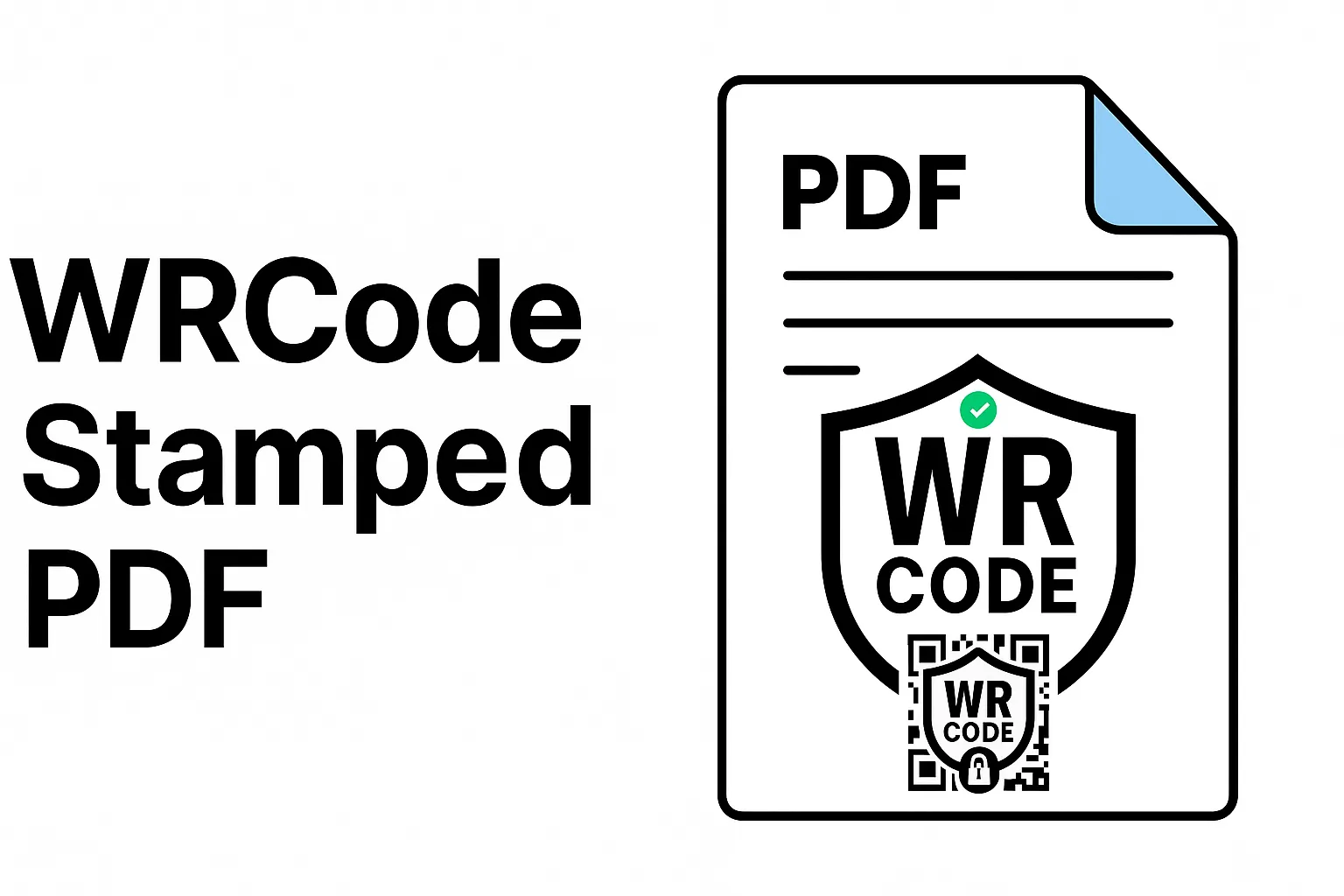
We propose WRCode Stamped PDFs: a lightweight, open-source protocol that embeds a WRCode QR block into the document footer. This WRCode encodes a signed reference to the document’s content hash, tool/template used, and the originating WRCode identity, all anchored to a distributed ledger (e.g., Solana, Optimism, IOTA). The result is a self-contained, auditable document format that supports offline validation, local generation, and regulatory transparency.
- System Overview
Each WRCode Stamped PDF is created through a controlled rendering tool (e.g., LibreOffice headless, LaTeX, or WeasyPrint) that ensures deterministic output. The WRCode QR block is added during or after rendering and encodes:
- SHA256(PDF document content)
- Template/tool version identifier
- Sender identity bound to a verified account at wrcode.org
- Timestamp of generation
- Solana reference (transaction hash or Merkle root)
Templates are defined by their visual structure and tool version, and must be transparent, open source, and auditable. They are published on WRCode.org and may be forked under open terms, but must be registered and anchored on WRCode.org before use. Anchors are created through Solana messages containing a hash of the document metadata bundle. This requirement ensures that all templates used in document generation are tamper-proof, transparently verifiable, and auditable. By mandating registration and anchoring of templates, WRCode Stamped PDFs operate under a zero-trust assumption: no rendering tool or layout logic is implicitly trusted unless independently verifiable via WRCode.org.
- Security Properties
- Integrity: The document’s content hash is tamper-evident and verifiable.
- Origin Assurance: Sender identity is cryptographically linked to a registered wrcode.org account.
- Anchor Immutability: Anchored hashes on Solana cannot be altered or deleted. No personally identifiable information (PII) is shared or leaked in this process—only cryptographic hashes of the document and related metadata are stored.
- Online Verifiability: The WRCode can be scanned from print or screen and validated using a WRCode scanner with an active internet connection. Real-time verification is handled by local PostgreSQL-based integrity checks combined with Merkle tree structures. All relevant proofs are immutably stored and periodically batched for anchoring on performant public blockchains such as Solana or Optimism. Additionally, anchoring to Solana provides long-term, tamper-evident integrity for archival purposes. Blockchain anchoring is not optional but forms the foundation for traceable, cryptographic auditability. All components are open-source and locally executable.
- Applications
- Invoice & Payment Authenticity: Proof that an invoice is genuine and unaltered.
- Regulatory Compliance: Financial, legal, or HR documents with verifiable origin.
- AI-Generated Document Trust: Allows AI-generated outputs to be anchored and traced.
- Automation Triggers: WRCode only functions online and requires an active internet connection to verify anchors and registered templates. It can act as an authenticated trigger for scanning agents or connected devices once verification is complete. can act as an authenticated trigger for scanning agents or devices.
- Comparison to Existing Approaches
Feature | WRStamped PDFs | PKI Signatures | Cloud Signing Platforms |
Local generation | Yes | Partial | No |
Offline validation | Yes | Often no | No |
Vendor lock-in | No | Yes | Yes |
Human-readable WR | Yes | No | Partial |
Identity privacy | Account-bound, selectively disclosed | Always exposed | Always exposed |
- Implementation & Toolchain
WRCode Stamped PDFs can be created using a signed local binary (e.g., wrstamp-tool) that integrates:
- Deterministic PDF generation (LibreOffice, LaTeX, etc.)
- WRCode embedding
- SHA256 hashing
Blockchain anchoring (e.g., Solana, Optimism) and optional IOTA archival submission. Proofs are structured via Merkle trees and batched before anchoring
Verification tools include:
- Mobile and desktop QR scanner apps
- Browser-based WRCode checkers
- Vault-integrated agents within orchestration systems like OpenGiraffe
- Zero-knowledge identity binding to WRCode hashes
- Selective disclosure of sender metadata
- Interoperability with Verifiable Credentials and EU eIDAS 2.0
- Formal WRCode Template Specification & governance via wrcode.org
Conclusion: WRCode Stamped PDFs present a novel composition of well-understood cryptographic primitives and distributed anchoring techniques, arranged to meet real-world demands for verifiable, privacy-preserving document automation. While components like QR-based hash encoding and cryptographic-based anchoring have precedent individually, their integration into a trustless protocol combining deterministic document generation, auditable template registration, identity-bound WRCode issuance, and protocol-conformant scanning represents a previously undocumented solution architecture.
This work is released as an open-source invention disclosure. It is not a formal patent application, and the author makes no exclusivity claims. While every effort has been made to verify originality at the time of publication, the author explicitly disclaims legal warranties of novelty or non-infringement. Readers, implementers, and derivative authors must perform their own due diligence before reuse, especially in regulatory or commercial contexts. Importantly, WRCode extends beyond static document verification. It also acts as a secure automation trigger for downstream AI agents—unlocking verifiable, automated workflows such as invoice parsing, bookkeeping, or compliance auditing. This convergence of verification and automation adds a uniquely powerful dimension not found in existing PDF signing ecosystems.
By openly publishing this system and binding it to a ledger-verifiable governance model, WRCode establishes a foundation for interoperable, tamper-evident documentation standards—designed for human readability, machine validation, and scalable trust without reliance on vendor-specific signing infrastructure. This publication is timestamped to serve as a public contribution to the open-source and academic community. All described mechanisms and templates will be released under an attribution-permissive license via wrcode.org.
Additionally, the WRCode protocol supports advanced AI-driven automation workflows. Once a WRStamped PDF is verified, additional AI agents can be triggered to perform deep invoice analysis or initiate fully automated bookkeeping processes. This extends the protocol beyond passive verification, enabling a trustless automation layer anchored in verifiable document integrity.
WRCode Stamped PDFs enable a new class of verifiable documents, combining privacy, open standards, and ledger-based proof of integrity. By anchoring document metadata and hash in a distributed ledger and embedding the resulting proof as a WRCode QR, this protocol provides scalable, user-friendly trust infrastructure for both digital and paper-based workflows.
This publication serves as an initial disclosure and timestamped record of the invention. The author explicitly disclaims any warranty of novelty or non-infringement. This work is provided purely for the benefit of the open-source and academic community, and no exclusivity or intellectual property claims are asserted. Readers and implementers are advised to conduct their own due diligence before reuse or deployment in regulated or commercial environments. All protocols, structures, and implementation logic described herein will be released under an open, attribution-permissive license and further documented at wrcode.org.