
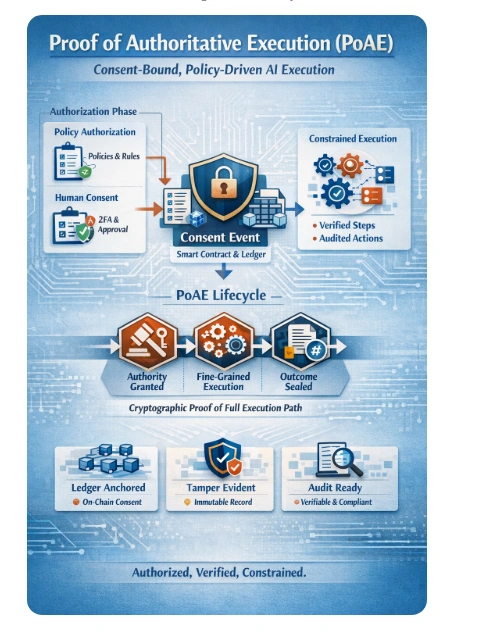
🔐 Proof of Authoritative Execution (PoAE) — Consent-Bound, Policy-Driven AI Execution
Proof of Authoritative Execution (PoAE) cryptographically proves the entire authoritative execution lifecycle of an automation process — from policy enforcement or explicit human consent, through all fine-grained execution steps, to the final output — under a verifiable and auditable trust boundary.
PoAE does not merely attest what happened; it proves why execution was permitted, under which authority, and under which enforced constraints.
🧭 Authoritative Execution Lifecycle
A valid PoAE MUST cover the following execution phases, depending on the domain and configuration:
Authority Establishment
Consent or Policy Authorization
Constrained Execution
Fine-Grained Step Verification
Outcome Sealing
Each phase is cryptographically bound into a single PoAE artifact.
🔑 Authority & Consent as First-Class Cryptographic Events
Consent Is an Execution Primitive
In PoAE, consent is not metadata — it is an execution gate.
Execution may only proceed when at least one of the following authorization mechanisms is satisfied:
Policy-driven authorization
Predefined organizational or system policies
Role-based access rules
Contextual constraints (domain, time, device, location class)
Explicit human consent
Manual approval
Strong confirmation (e.g. 2FA, passkey, hardware key)
Domain-specific confirmation flows
The authorization event itself is cryptographically captured and becomes a mandatory part of the PoAE chain.
🔗 Ledger-Anchored Consent (Optional but Canonical)
PoAE explicitly allows — and in high-assurance domains may REQUIRE — that consent events be:
Enforced by smart contracts
Anchored directly on a distributed ledger
Represented as a verifiable authorization transaction
Examples:
A smart contract that requires:
2FA confirmation before execution
Multi-party approval (e.g. legal + compliance)
A ledger entry where:
The consent hash is embedded directly into the ledger state
Execution references the ledger transaction ID as authority proof
In this model, the ledger itself becomes the source of execution authority, not merely a timestamping layer.
PoAE supports both:
Ledger-enforced consent
Off-ledger consent with ledger anchoring
without requiring disclosure of sensitive user data.
🧩 Fine-Grained Execution Proof
Once authority is granted, PoAE cryptographically binds:
Each automation step
Each policy checkpoint
Each delegated agent action
Each conditional branch or optimization decision
into a step-level execution trace.
This enables:
Domain-specific verification (finance, healthcare, legal)
Post-hoc auditability
Forensic reconstruction of execution paths
Regulatory review without replaying private data
Execution steps may be:
Fully local
Hybrid (edge + cloud)
Smart-contract mediated
Human-in-the-loop
All are treated uniformly within PoAE.
🧾 What PoAE Cryptographically Proves (Expanded)
PoAE proves:
Who was authorized to execute
How authority was granted
Policy
Manual consent
Ledger-enforced contract
Which policies were active
Which automation steps executed
In what order and under which constraints
Which outputs were produced
That no execution occurred outside authorized boundaries
Importantly, PoAE proves absence of unauthorized execution, not just presence of execution.
📦 Consent-Bound PoAE Artifact (Conceptual)
A PoAE artifact MAY include:
Consent hash (manual or policy-derived)
Ledger transaction reference (if used)
Smart-contract address + rule set
Identity proof (domain / role / ZKP)
Execution graph and step hashes
Output snapshot hash
Temporal constraints
Revocation or expiration markers
All sensitive data remains local or zero-knowledge protected.
🛡️ Why This Matters (Strategic Framing)
This framing makes PoAE fundamentally different from:
Execution logs
Audit trails
Orchestration traces
Model provenance records
PoAE is an execution-authorization proof, not an explanation artifact.
It allows AI systems to operate autonomously only within explicitly granted authority, and to prove — cryptographically — that they never exceeded it.
This becomes essential when:
AI systems act faster than humans
Decisions carry legal or financial impact
Responsibility must remain human-traceable
Governance cannot rely on trust alone