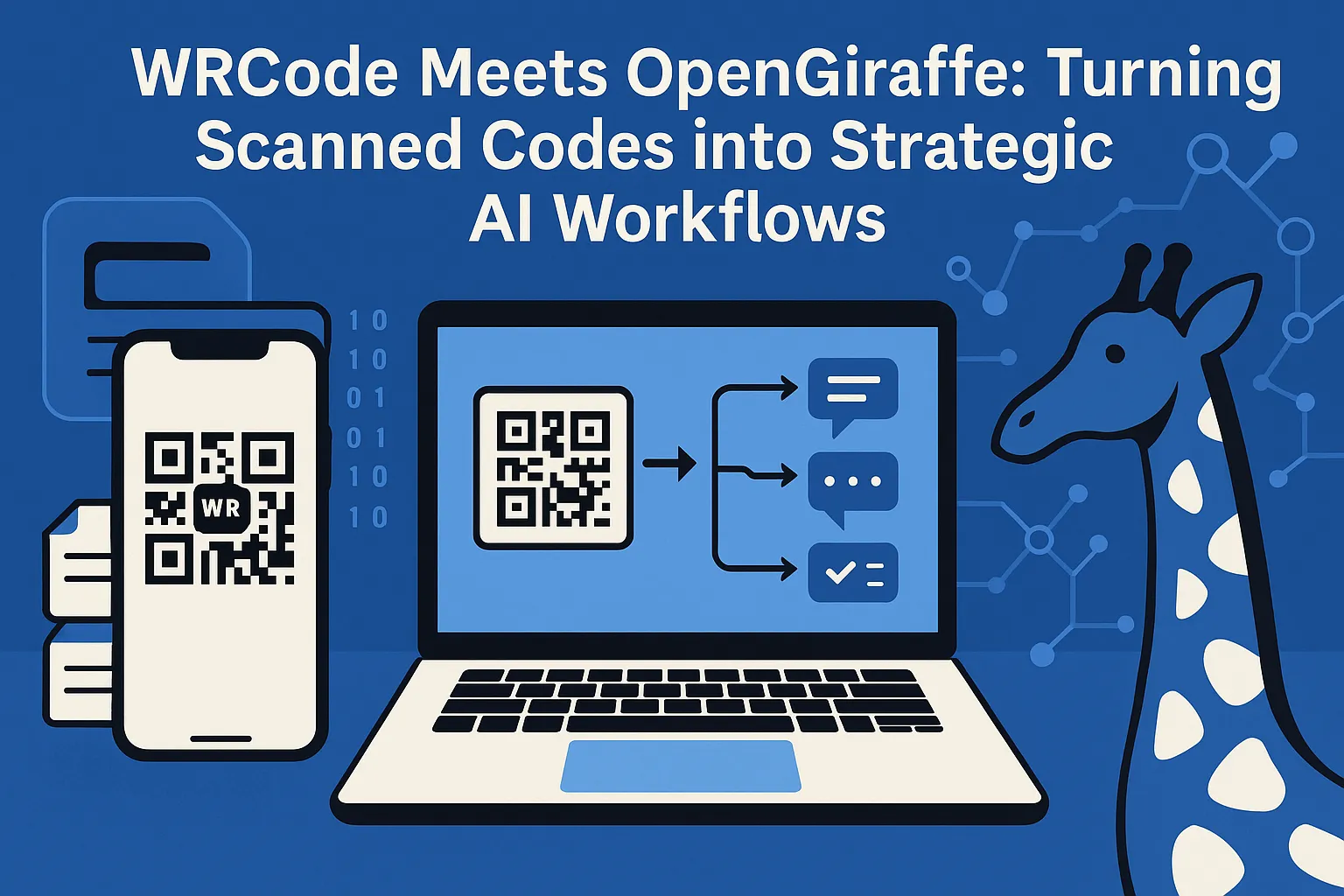
QR codes have long been used to link users to websites, apps, or actions—but in a world where automation and AI are rapidly reshaping business and daily life, this old paradigm falls short. The future isn’t about static links. It’s about actionable intelligence. And that’s where WR Codes and OpenGiraffe intersect.
🧠 From Scan to Strategy
WR Codes (Workflow-Ready Codes) look like standard QR Codes, but they carry something far more powerful: embedded instructions for AI agents. These structured templates—cryptographically signed and transparently registered on wrcode.org following the WRCode guidelines—are what make secure, tamper-proof processing possible. Registration is not just a formality; it’s the foundation that enables trusted execution, feature access, and seamless integration within the ecosystem. While customer-facing templates are fully public, auditable, and pre-scanned by AI, a small number intended for private or internal use may be withheld from public disclosure. In such cases, the publisher must clearly communicate this, and the user is shown a warning prior to execution—ensuring informed consent and accountability. Importantly, all templates—whether public or private—are registered immutably and cannot be altered post-registration. This guarantees the integrity of the automation instructions even in non-disclosed scenarios, maintaining trust and verifiability at all times.—transform the humble scan into a trusted automation trigger. But the true magic begins when these WR Codes are captured and analyzed by OpenGiraffe, the browser-based AI orchestrator developed by Optimando.ai.
⚙️ Why OpenGiraffe Unlocks WRCode’s Full Potential
When a WR Code is scanned on a mobile device, its payload is stored securely. But instead of triggering blind execution, the payload can later be routed to a local OpenGiraffe instance—running on a workstation or even a laptop. Here, the real transformation begins:
AI templates inside the WR Code define pre-auditable** workflows**—for example:
Automated bookkeeping
Contract generation
Document filing or email drafting
These templates are passed to modular AI agents inside OpenGiraffe, each running independently in browser tabs or a unified orchestrator page.
The result is a fully explainable, interactive, and user-controlled automation, rather than a silent script or server-side logic.
🔁 Strategic Optimization: Where AI Meets User Intent
OpenGiraffe doesn’t just “run the AI instructions”—it reasons about them. Its built-in optimization layer evaluates potential risks, checks the user’s calendar and context, and surfaces smarter or more efficient alternatives. This ensures that workflows are not only executed safely, but also aligned with the user’s intent, availability, and priorities—before anything happens.
Imagine scanning a WR Code for a new supplier registration. Instead of blindly filling out a form, OpenGiraffe might:
Detect missing tax info or payment terms
Compare past supplier entries for best practices
Prompt you to pre-approve email drafts, contract clauses, or calendar entries
All of this happens in a transparent, modular interface, where every action can be traced, paused, adjusted—or denied.
🔐 Trust, Privacy, and Local Control
In contrast to cloud-based automation tools, OpenGiraffe is locally hosted, privacy-first, and fully under user control. It integrates with tools like n8n for backend tasks and uses local or hybrid LLMs (e.g., GPT-4, Claude, Mistral, or LLaMA) to handle reasoning.
Each WR Code is:
Anchored on IOTA for tamper-proof authenticity and immutable verification
Issued by verified providers who must register and prove their identity—this identity proof is also anchored on IOTA
Restricted to registered templates only—unregistered WR Codes or AI templates are automatically rejected by apps that comply with the security guidelines defined by wrcode.org
Verified locally before execution, ensuring the user stays in full control at all times
This layered architecture ensures that no automation can be executed unless it adheres to strict security protocols defined by wrcode.org—including user consent, verifiable audit trails, and cryptographic proof of authenticity. Every WR Code must originate from a verified provider, and only registered templates are accepted. This registration requirement makes every process tamper-proof, auditable, and enforceable, ensuring users remain fully informed and in control—whether reviewing a calendar draft, an email, or a generated report. Moreover, the secure vault used to store and execute these automations holds personally identifiable information (PII) and sensitive data. It must comply with strict implementation guidelines, and its codebase is vetted, open source, and cryptographically protected. Configurations are trustless—no provider can alter the code once deployed. Any modified vault implementation simply won’t function within the WRCode.org ecosystem due to real-time integrity checks. These checks ensure that only unaltered, verified, and cryptographically sealed vault configurations are permitted to operate—preserving the system’s trustless and tamper-proof guarantees. The vault is responsible for storing personally identifiable information (PII) and sensitive data, making its integrity critical. On mobile devices, lightweight LLMs may be used to process logic securely. On workstations, the LLM configuration is flexible but always bound by tamper-proof, verifiable constraints—ensuring data sovereignty and trustworthy automation execution.
🧩 WRCode as the Standard for Secure, AI-Driven Automation
WR Codes are not proprietary—they’re a proposed open standard built on QR Code model 40 (ISO/IEC 18004). Registering a WR Code is what enables secure, tamper-proof automation to unfold within the orchestration ecosystem. Whether the template is public or private, registration ensures integrity, prevents unauthorized changes, and unlocks safe, explainable automation through OpenGiraffe. Their innovation lies in how they’re used:
As portable AI instruction carriers
As context-aware automation triggers
As secure gateways to orchestration—not black boxes
When combined with OpenGiraffe, WR Codes become part of a next-generation infrastructure for decentralized, explainable, and privacy-preserving AI workflows.
🖥️ Mobile vs. Workstation: Scale Matters
While WR Codes are typically scanned on mobile devices, the optimization layer is inherently limited by the small screen and lightweight resources available. To bridge this, WR Code scans are automatically stored on the mobile device and can be synced with the OpenGiraffe orchestrator—so they can later be explored in full depth on a workstation. This unlocks advanced orchestration and reveals strategic insights that go far beyond what mobile devices alone can deliver. On mobile, a single background process handles lightweight optimization tasks if enabled, keeping the experience smooth and user-friendly. But the full power of WR Code automation unfolds on multi-screen desktop workstations running OpenGiraffe or on other compatible multi-agent ai orchestrator solutions.
Here, users can:
Visualize multiple agent outputs in parallel
Run deep strategic analysis and cross-checks
Trigger complex, multi-step workflows
Leverage immersive interfaces with flexible slot-based layouts
This architecture offers unlimited flexibility and insight, enabling professionals to orchestrate intelligent, explainable, and highly customizable workflows that simply aren’t possible on mobile-only systems.
🚀 Real-World Impact
Here are just a few examples:
Accounting: Scan a WR Code on an invoice → OpenGiraffe launches a bookkeeping automation that extracts data, cross-references contract terms, and suggests ledger entries. On supported platforms, websites can dynamically generate personalized WR Codes on the invoice itself—adapting embedded AI templates to match the user’s preferences, historical settings, or account profile. The level of personalization and automation depends on how finely the service provider defines the AI instructions inside the WR Code template. When designed with care, this enables fully automated, user-tailored bookkeeping workflows with minimal effort—streamlined, secure, and fully explainable.
Legal: A contract’s WR Code triggers clause verification, AI-guided summary, and a secure signature interface.
Field Ops: A technician scans a WR Code on-site → the orchestrator opens a live support workflow, suggests steps, and logs actions locally or immutably.
Each action is precise, auditable, and completely under human oversight.
🧠 In Summary
WR Codes are the ignition key. OpenGiraffe is the engine. WR Codes are already powerful when scanned on mobile devices—but they become truly magical when connected to OpenGiraffe. This seamless handoff unlocks their full orchestration potential, enabling deep analysis, personalized automation, and trustworthy execution across complex workflows.
Together, they transform passive QR scans into intelligent, contextual, and strategic automation—running on systems you control, with logic you can inspect, and outcomes you can trust.
This is the future of automation—conceptual, but already taking shape. WR Codes and OpenGiraffe outline a powerful vision for intelligent, secure, and explainable workflows, designed to operate in an open, local, and user-controlled ecosystem. While the full system is still evolving, the foundation has been laid—and its potential is within reach.