Modern AI systems are extraordinarily capable—but also dangerously observant.
Every time you ask a chatbot to help with a personal or professional task, it learns more than you think. Over time, your queries can expose patterns: who you are, what you do, how you think.
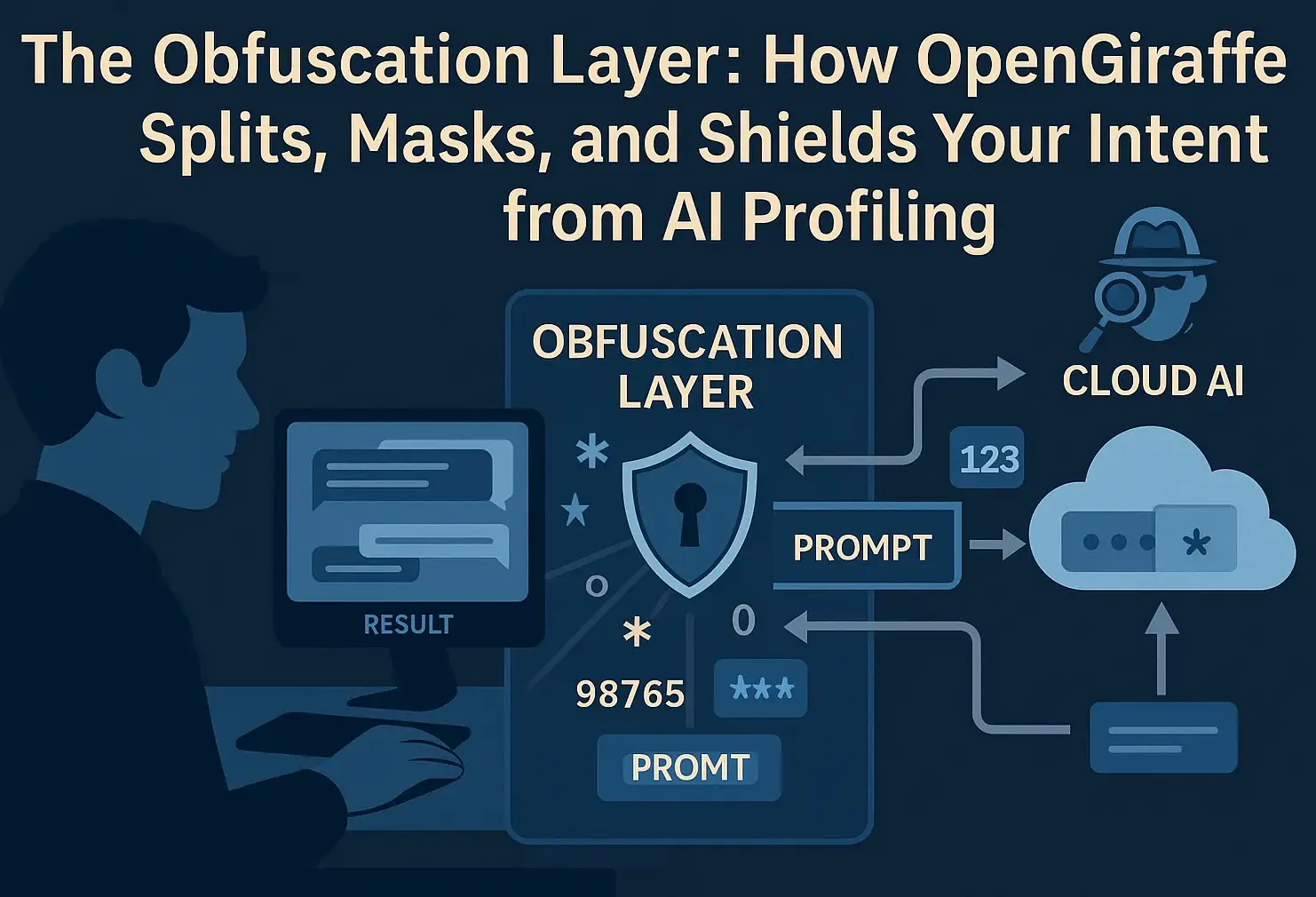
To prevent this silent profiling, OpenGiraffe introduces the Obfuscation Layer—an optional, evolving defense system that scrambles sensitive prompts, splits logic paths, delays execution, and re-routes critical data away from external models.
 What Is the Obfuscation Layer?
The Obfuscation Layer is an optional privacy-first component within OpenGiraffe’s orchestration system. It’s designed to prevent oversharing with LLMs, especially when cloud-based APIs are involved (e.g., OpenAI, Anthropic, Gemini, Deepseek, Grok).
Once enabled, this layer actively monitors outgoing prompts and applies a mix of filtering, masking, prompt splitting, obfuscation, and routing logic. Its goal: to make AI helpful—but ignorant of your private life and strategic context.
 How It Works: Core Tactics
1. Prompt Classification & Criticality Detection
Prompts are broken down into logical units.
Each unit is scored for risk (e.g., names, dates, salaries, roles).
Critical content is routed differently than harmless filler.
2. Hybrid Prompt Splitting (Local + Cloud)
Critical fragments are routed to locally hosted LLMs (e.g., LLaMA 3, Mistral).
Non-sensitive content is routed to cloud-based LLMs.
This allows performance without full data exposure.
3. Masking & On-Demand Demasking
Personally identifiable information (PII), sensitive numbers, or unique metadata are masked locally.
Only upon user confirmation can these be used in output.
4. Prompt Obfuscation & Confusion
Fake sub-prompts and decoys are generated using Tree-of-Thought Confusion.
The goal is to break intent recognition by introducing false paths.
5. User Nudging & Input Delay
If sensitive data is detected in raw input, the system pauses and asks for confirmation.
This prevents accidental leaks.
 A Real-World Example: The Travel Booking Trap
Imagine Lara, a freelance journalist working on a sensitive investigation.
Using a cloud-based LLM via OpenGiraffe, she:
- Books a Flight
Books a hotel
Rents a car
- Reserves a table at a restaurant
Fills out insurance forms
Writes a press letter
In doing so, she enters:
Name, birthday, passport details
Locations, dates, and affiliations
Purpose of visit and logistics
If this data is sent raw to a cloud LLM, it could be:
Logged permanently
Used to train future models
Subpoenaed in foreign jurisdictions
Leaked during breaches
For Lara, this is more than a privacy concern—it’s a risk to her safety.
Other high-risk groups include:
NGO workers
- Politicians
- Labour Union
- Military personell
Scientists with active patents
Corporate executives
Lawyers or witnesses in trials
Rich people, Influencers
For these users, intent obfuscation isn’t optional—it’s essential.
And it’s not just a theoretical concern. History shows us that even the most trusted cloud providers and corporations have suffered massive data breaches. Customer records, internal tools, and sensitive documents have been leaked—and sold in darknet markets.
Organized cybercrime groups are technically advanced, often better funded than security teams. Some users use any chatbot suggestion they find trending online—without hesitation, without context, without even having the slightest concerns. But what happens when these “trusted” platforms are infiltrated, backdoored, or misused by insiders? In some parts of the world, even governments are actively complicit in criminal operations—spying on dissidents, persecuting whistleblowers, or exploiting data from compromised platforms. We live in a time of war, bloodshed, and hatred in the streets—where digital trust is fragile and information can be weaponized. For high-risk individuals, casual interaction with AI systems is not just risky—it can be dangerous.
It’s not all sunshine out there. The Obfuscation Layer is designed for those who are most vulnerable to these threats. Open Source, always ready to improve and evolve.
With the Obfuscation Layer enabled:
Cloud models receive non-critical filler or vague templates
Local models process sensitive data, sensitive names and routing logic
No single system sees the complete context. Workloads are distributed
This makes profiling difficult. The heavy obfuscation happens directly inside the browser—on your own device—before any data reaches an external model. What’s shown on your screen is rendered locally, filtered through the orchestration logic that knows what’s real. The cloud AI only sees fragments, confusion, and plausible decoys. It cannot see where the journalist booked her flight, rented the car, or reserved the hotel—nor can it piece together what exactly she was working on. The AI may see one plausible route among ten—but only your device knows what’s real. Real actions happen on the actual sites, not through the AI.
 Ongoing Research, Evolving Defenses
The Obfuscation Layer is a live research field. It continues to evolve with:
Live sensitivity scoring
Role-based redaction profiles
Math over encrypted values
Tree-of-Thought decoys
ZK-proof-based masking
A single prompt is fragmented into reasoning units and distributed across multiple cloud-based AI models to prevent full visibility at any single endpoint.
The goal is clear:
To reduce the LLM’s ability to extract meaning while still letting it perform the task. It starts experimental but will evolve over time into a reliable obfuscation layer.
 Conclusion: Use AI, Without Being Used
AI shouldn’t require sacrifice. With the Obfuscation Layer, OpenGiraffe users get the best of both:
Powerful, real-time automation
Zero profiling, maximum control
You decide:
What gets shared
What gets masked
Where it goes
In the age of intelligent systems, strategic obfuscation can be a powerful defense. OpenGiraffe’s local obfuscation layer helps shield sensitive user behavior from unintended exposure. While this adds token overhead and may be disabled by some, even minimal augmentation and real-time warnings can meaningfully reduce data leakage risks.
Though no system can eliminate threats entirely, OpenGiraffe supports practical mitigation aligned with the EU AI Act — promoting on-device privacy, contextual safety, and responsible automation. It also reinforces IP protection and regulatory readiness through built-in safeguards.